

Updated: October 31, 2026
In printing, DTF stands for direct-to-film. Your design is printed on a clear plastic (PET) film, coated with an adhesive powder and cured. Then a heat press applies it to the garment, and the film peels away.
You don't need a DTF printer to use it. You can order custom DTF transfers by size or a full DTF gang sheet (several designs on one sheet), and they arrive printed, powdered and cured, ready to press. (DTF is also a texting abbreviation with a very different meaning. This guide is only about printing.)
What Does DTF Mean in Printing?
DTF stands for direct-to-film. The "direct" part refers to the film: the printer puts the ink straight onto a transfer film, not onto the shirt. That's the key difference from DTG (direct-to-garment), where the printer lays the ink right on the fabric. With DTF, the design reaches the garment later, through heat and pressure.
You'll see the same method called DTF printing, DTF transfers or direct-to-film transfers.
What Is a DTF Transfer?
DTF printing is the process. A DTF transfer is the product you hold in your hand: a printed design on film, ready to apply. It has three parts:
- The printed design, in full color, made to stay bright on light and dark garments.
- A layer of adhesive, the cured powder that bonds the design to the fabric when you press it.
- The carrier film, the clear sheet that holds everything in place until you peel it off after pressing.
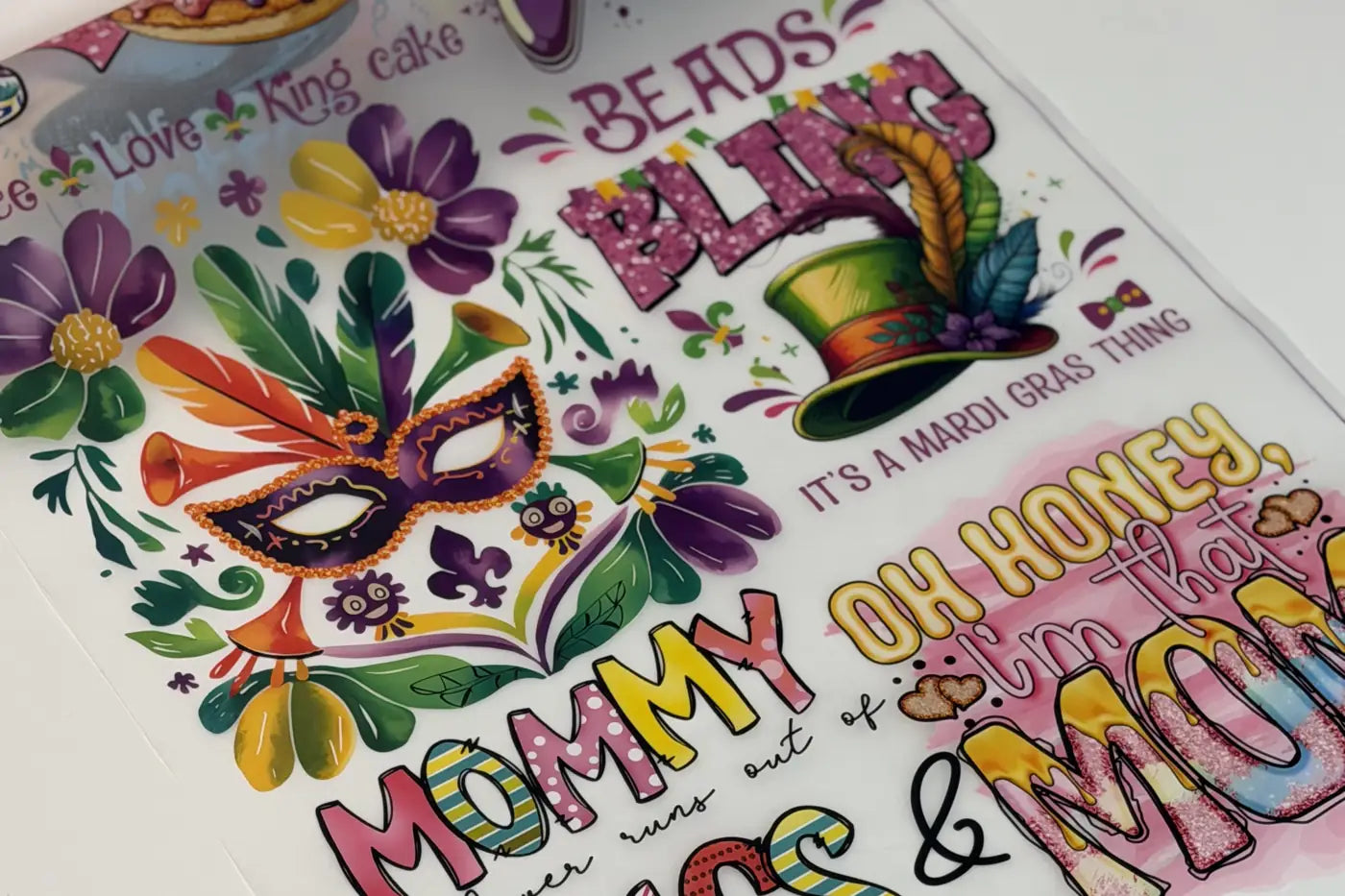
For a closer look at ordering and using them, see what a DTF transfer is and how to use one.
How Does DTF Printing Work?
There are two stages: making the transfer and applying it. If you order ready-to-press transfers, we handle the first stage and you only do the second.

Making the Transfer
- Prepare the artwork. A high-resolution PNG with a transparent background works best.
- Print the design onto PET film with a DTF printer and DTF inks.
- Apply the adhesive powder while the ink is still wet, then remove the excess so the powder stays only on the printed areas.
- Cure the powder in a curing oven or under a heat press, following the settings for your powder, film and equipment.
Our ready-to-press transfers arrive already cured, so you skip these four steps.
Applying the Transfer
- Use a lint roller, then pre-press the garment for about 5 seconds to remove moisture and wrinkles.
- Place the transfer powder side down and press with the settings for your fabric.
- 100% cotton: we press at 300-310°F (149-154 °C) for 10 seconds in our shop.
- On your own press, start at 300-320°F (149-160 °C) for 10-15 seconds and test on a scrap of the same fabric first. Every press reads a little differently.
- Use firm pressure on a manual heat press. You should feel real resistance when you close it.
- Peel the film. Hot peel (our standard): open the press, count 2 to 5 seconds and peel. Cold peel and glitter: wait until the film is completely cool.
- Finish with a final 10-second press, covering the design with a Teflon sheet for a glossy finish or a linen cloth for a matte finish.
Polyester, blends and nylon use different settings. Nylon, for example, needs medium-light pressure at 260-275°F (127-135 °C) for 10-12 seconds. You'll find every fabric in our DTF pressing instructions.
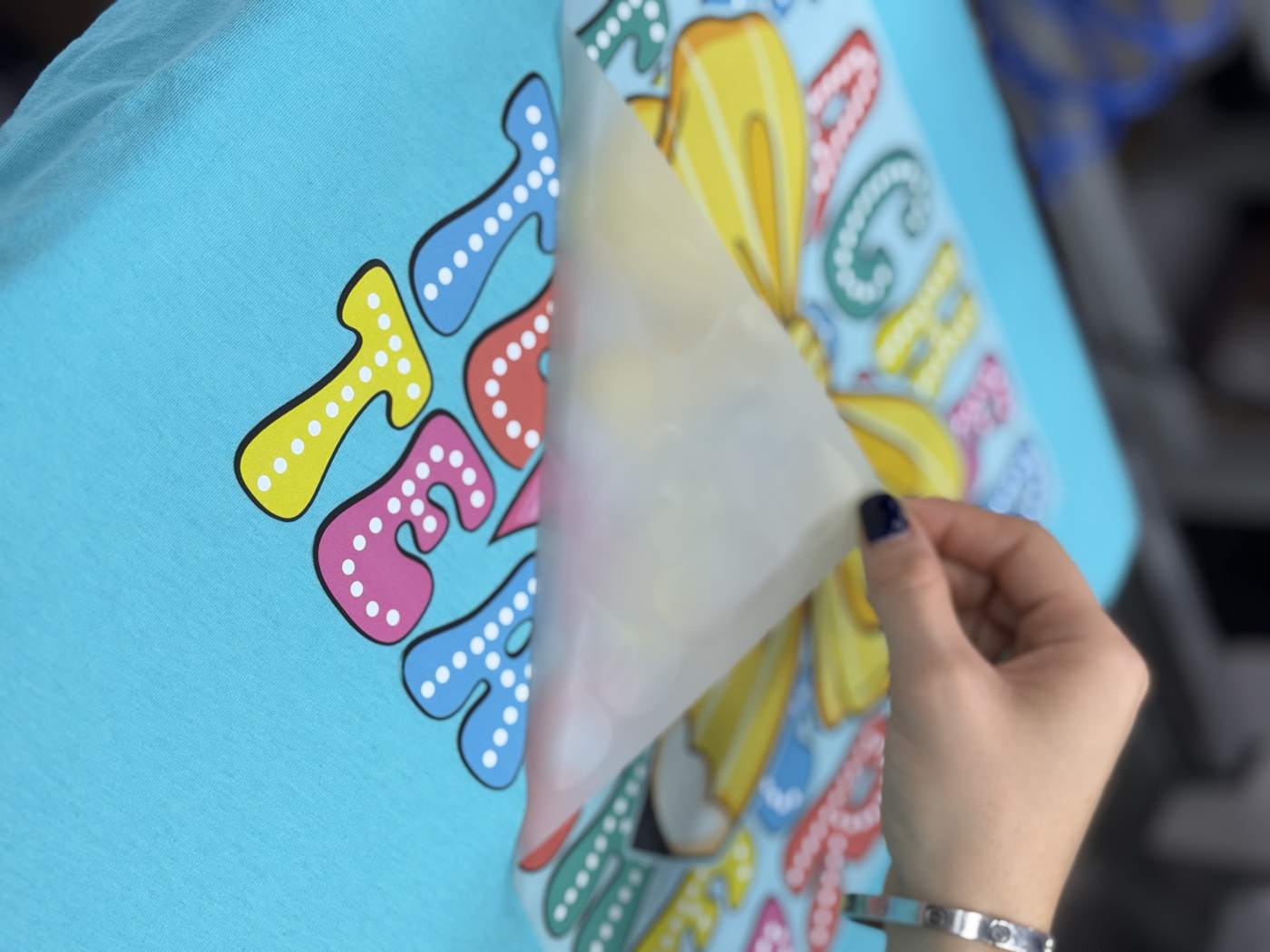
Do You Need a DTF Printer to Get Started?
No. There are two ways to work with DTF, and only one of them needs a printer.
The first is to order ready-to-press transfers. We print, powder and cure them; you press them. You need a heat press and a Teflon sheet or a linen cloth. A household iron can work for a test, but it doesn't give the even, firm pressure DTF needs, so the print won't last as long.
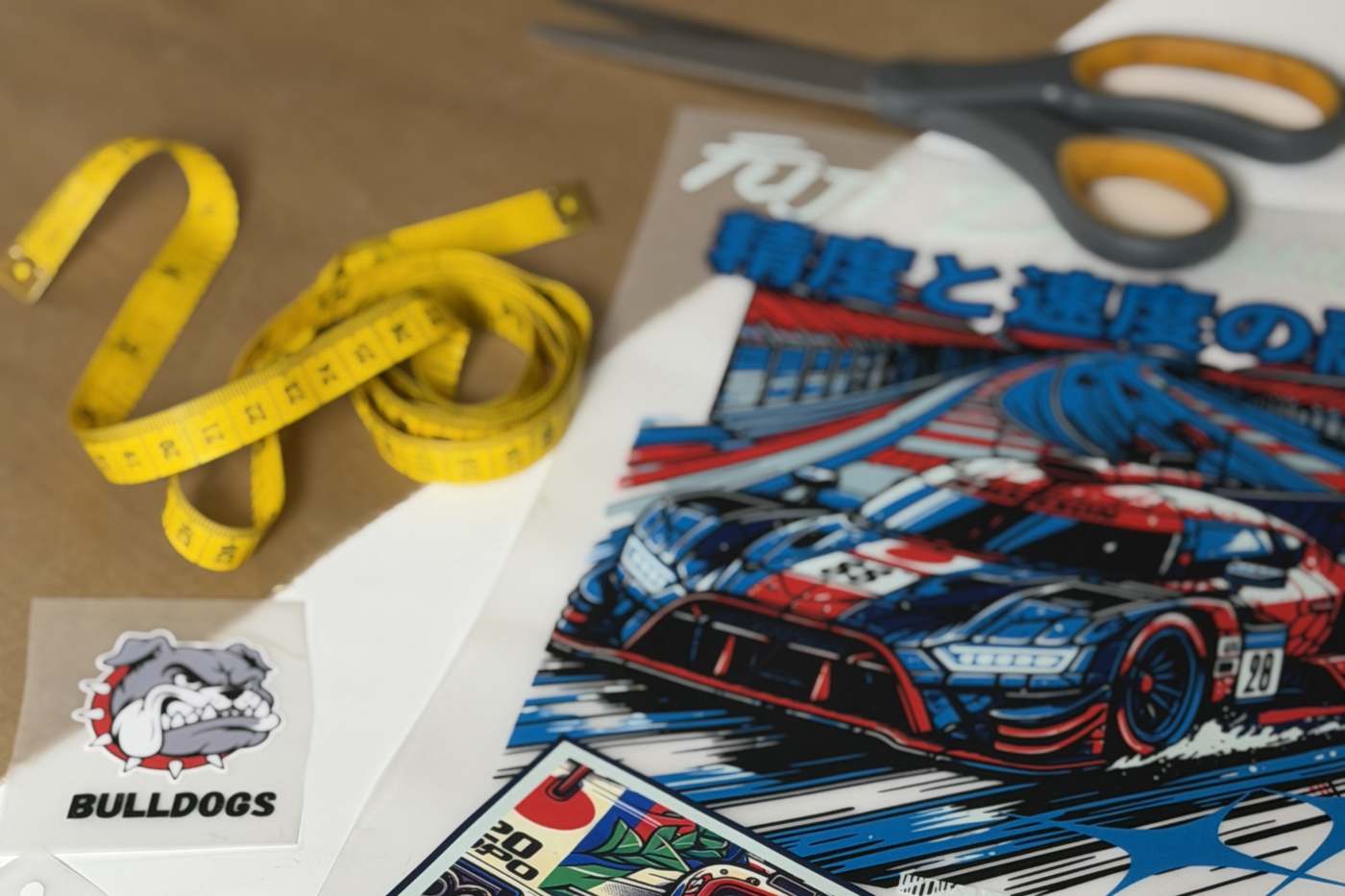
The second is to print in-house. That takes a DTF printer, DTF inks, film, adhesive powder, curing equipment, design software and a heat press, plus time for regular printer maintenance. It fits shops that print often enough to keep the equipment busy.
Which Fabrics Work With DTF Transfers?
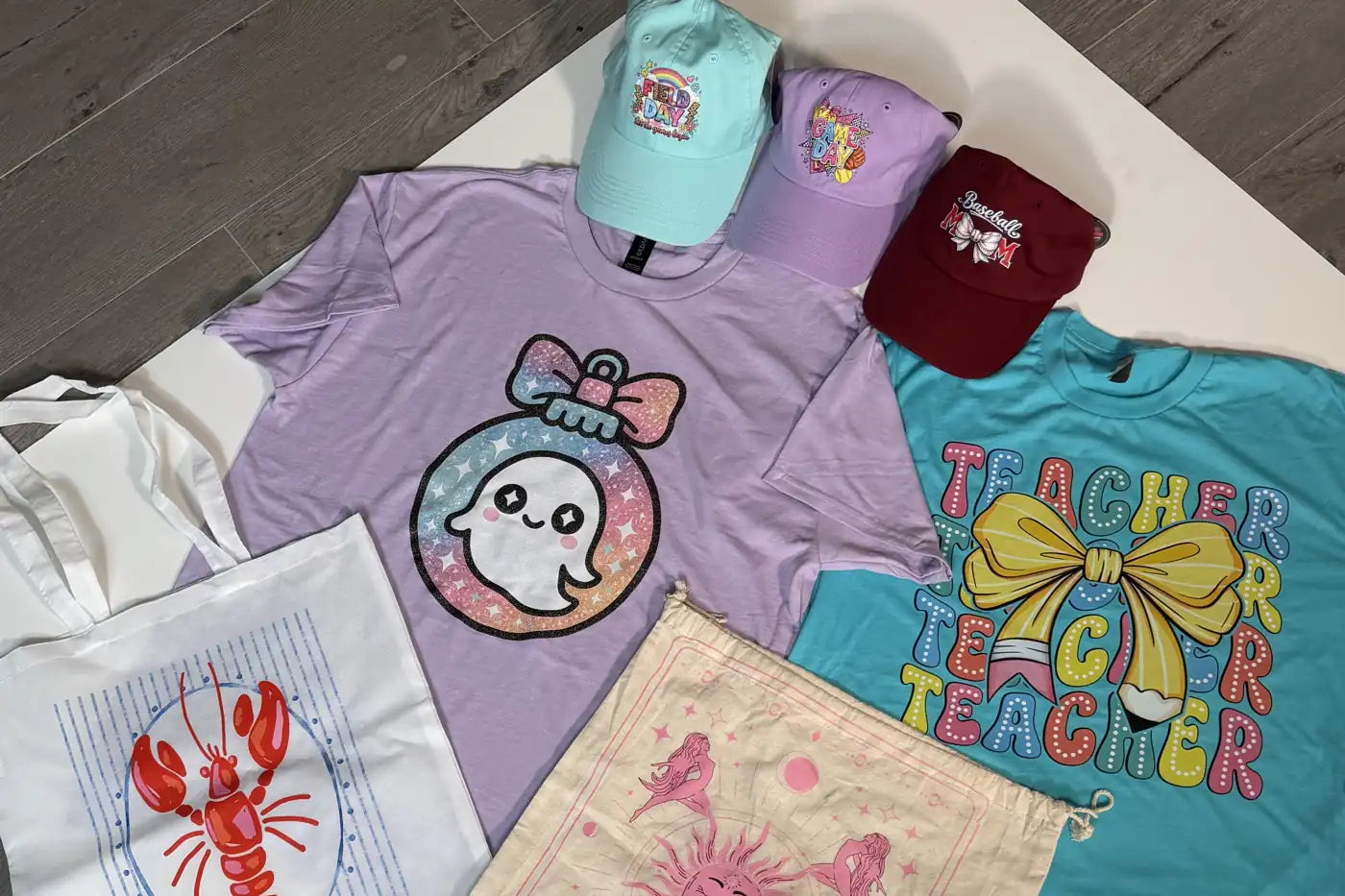
DTF transfers are made for fabric. Our pressing guide has settings for 100% cotton, cotton/poly blends, 100% polyester and nylon or performance fabrics. That covers most t-shirts, hoodies, sweatshirts, tank tops, tote bags, aprons and team uniforms.
Some garments need a test first: fabrics with a water-repellent or other coating, heat-sensitive synthetics and very textured knits. Press a scrap or a hidden spot before you run the whole order.
DTF isn't for hard surfaces. For glass, metal or ceramic, see the UV DTF section below.
DTF vs. Other Printing Methods
Here's how DTF compares with the other common methods.
| Method | How the design gets on the garment | Common uses | Main thing to watch |
|---|---|---|---|
| DTF | Printed on film, then heat pressed onto the garment | Full-color designs on cotton, polyester and blends; small and medium runs | Needs the right heat, pressure and peel; large solid areas feel heavier than the fabric around them |
| DTG | Printed straight onto the garment | Detailed designs on cotton | Dark garments usually need a pretreatment before printing |
| Screen printing | Ink pushed through a mesh screen, one screen per color | Larger runs of the same design | Each color needs its own screen and setup |
| HTV (heat transfer vinyl) | Vinyl cut to the shape of the design, weeded, then heat pressed | Names, numbers and simple shapes | Weeding takes time on detailed designs, and each vinyl color is usually its own layer |
| Sublimation | Ink turns to gas under heat and bonds into polyester fibers | White or light polyester items | Doesn't work on cotton or dark garments |
Screen printing is often a good fit for larger runs of the same design, especially with few colors. Each color needs its own screen, and that setup costs more up front. On small orders with many colors, that cost is spread across fewer garments, so DTF often costs less per garment.
For the details, compare DTF vs. DTG printing and screen printing vs. DTF.
DTF vs. UV DTF: Are They the Same?
No. Both use film, but they're different products for different surfaces. DTF is for fabric and goes on with a heat press. UV DTF transfers are cured with UV light and applied with pressure, no heat, to flat, hard surfaces like glass, ceramic, metal, hard plastic, acrylic and sealed wood.
UV DTF doesn't go on fabric or anything flexible, and regular DTF is made for fabric, not hard surfaces. The rule of thumb: UV DTF for hard surfaces, DTF for fabric. Here's how UV DTF transfers work.

Benefits and Limitations of DTF Printing
What DTF does well:
- Full color and fine detail, including gradients, shadows and small text.
- No contour cutting or weeding of the design. The transfer is printed in its final shape; on a gang sheet, you just cut the designs apart before pressing.
- It works on light and dark garments in cotton, polyester and blends.
- There are no screens to set up, so one-offs and small runs make sense.
- With correct pressing and care, our standard transfers last 50 to 100 washes.

What to keep in mind:
- A large solid area of ink sits on the fabric as one layer, so it feels heavier and lets less air through than the fabric around it. Designs with open space or a distressed fill feel lighter.
- Results depend on the application. The wrong temperature, light pressure or peeling at the wrong moment shortens the life of the print.
- Transfers waiting to be pressed don't like humidity. Store them flat in a cool, dry place.
Frequently Asked Questions
Is DTF the Same as Heat Transfer Vinyl?
No. Heat transfer vinyl (HTV) is a colored film that's cut to the shape of the design and weeded before pressing. A DTF transfer is printed, so full color, gradients and fine detail come in one piece, without weeding the design. Both go on with a heat press.
Can DTF Transfers Be Used on Dark Shirts?
Yes. Colors stay bright on black, navy and other dark garments, as well as on white and light ones. Use the press settings for the garment's fabric, not its color.
How Long Do DTF Transfers Last?
With correct pressing, including the final press, and the right care, our standard DTF transfers last 50 to 100 washes. Care means waiting 24 hours before the first wash, washing inside out in cold water, and skipping fabric softener and high dryer heat. We don't give a wash count for glitter transfers or for transfers applied with a household iron. Here's how long DTF transfers last and what shortens their life.
Do You Peel DTF Transfers Hot or Cold?
It depends on the film. Our standard transfers are hot peel: open the press, count 2 to 5 seconds and peel. Cold peel and glitter transfers need the film completely cool before you peel. If it's your first time pressing DTF, or the design has very fine details, let it cool completely before peeling, even on hot peel film.
Choose Your Next Step
Upload your PNG. We print, powder and cure it; you press it.
Ready to order? Order custom DTF transfers by size, or build a DTF gang sheet with several designs on one sheet.
Pressing for the first time? See the DTF pressing instructions.
Want to know what's inside a transfer? Here's what DTF transfers are made of.
About the Author
 Jennifer Linfozzi | Founder and Owner, DTF Transfers Now
Jennifer Linfozzi is the founder and owner of DTF Transfers Now, a DTF print shop in Kendall, Miami, that makes heat transfers for apparel businesses and print shops nationwide. She studied at the University of Florida, earned her MBA at the University of Miami, and is bilingual. The shop has been printing since 2006 and has specialized in DTF since 2022. Her guides explain DTF the way it's printed and pressed there every day.